2011年4月22日星期五

Presentation Material from SMBNation
Did you manage to make it to SMBNation 2010? Were you in the jammed packed rooms for ?Aurora? or ?SBS7?. Now that we have full product names, pricing and estimated release dates, it?s time to start talking about these great products.

While the names in the decks are unchanged, I am now making the SMBNation decks available to you for both sessions:
Windows Small Business Server 2011 Essentials (known at SMBNation as ?Aurora?), and
Windows Small Business Server 2011 Standard (known at SMBNation as ?SBS7?).
Click on the above links to download the decks presented.


Read Books by Email
Post from:
Read Books by Email
Microsoft releases IE10 preview, talks up native HTML5
Microsoft has released an early preview of Internet Explorer 10, which you can download now. It shows the company?s commitment ? for the moment ? to an energetic release cycle for its web browser.
Why use IE? Microsoft is pushing the notion that only IE is truly native on Windows:
IE10 continues on
...continue reading Microsoft releases IE10 preview, talks up native HTML5
Related posts:Windows Multi Point 2011 and How it Fits into Your Small Business
I?ve talked about Multi-Point before, and I mentioned it in my presentation at SMBNation in Las Vegas at the end of last year, but yet I still get the questions about education only, or can we use it in business?

Well, it?s true that the current version of Multi-Point, 2010 that?s available today is out in the field for education only (or at least it?s hard to get or manage if you?re not in education). If you?re in the market for it, because you like the idea of a single computer and multiple users, there were two major problems. The OEM edition was non-domain joinable, and only supported 10 users. The Academic version was only via volume licensing to qualified people, and supported 20 users and the beloved domain-join functionality. So really, if you wanted something useful, really do have to be in the education field to even get your hands on it.
Also, there are some features that are good for education, but kind of confuse users outside in the working world, like if you put a thumb-drive into one of the USB ports at a workstation, it appears to all the work stations. Good for education, not so great for business.
Well, if you wrote off Multi-Point 2010 for business, you probably haven?t been paying attention to the new Multi-Point 2011, currently in Beta (obtain it here)

With Windows MultiPoint Server 2011, the licensing and purchase model has been simplified. There are still two versions as before, with similar restrictions:
- Windows MultiPoint 2011 Standard ? still cannot join a domain and still has a max of 10 work stations
- Windows MultiPoint 2011 Premium ? CAN join a domain as before and can have up to 20 workstations
The most important piece of information to note in the SMB space, is that BOTH of these MultiPoint editions are offered in multiple Microsoft licensing channels. So now you don?t have to be a large school to actually purchase the more useful edition of MultiPoint.
What?s better, is that USB issue mentioned above is fixed, a USB thumb-drive only appears to the session its plugged into, and not all the users on the server.
Additionally, the 2011 version of WMS has support for thin clients. Here is where I think the big win for Small Business lives. If you have 12 XP workstations, you can simply obtain 1 copy of MultiPoint Premium and now each of those XP workstations have another 5 years of life but yet, they get a full Windows 7 experience when used as a WMS workstation over the network.
What??
Yeah, that?s what. WMS is essentially a turnkey TS server on steroids. You can TS to it, or you can plug in USB based workstations, or use OS down-level desktops. I?ve even seen old useless Linux based laptops, that have support for RDP be instantly turned into a powerful Windows 7 workstation.
If you?re a VAP, selling it should be a breeze. Just show the business owner the console where you can get a thumbnail of each individual workstation. Business owners will love that they can snoop on their employees desktops for when they are using Facebook, or other non-productive functionality, or even to just confirm employee behavior.
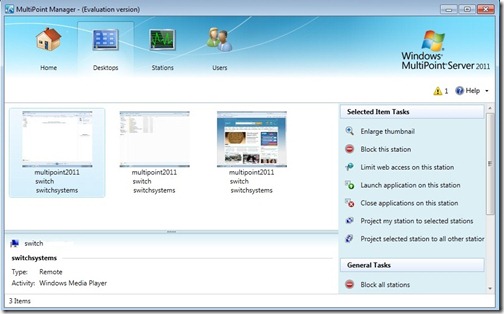
You can really tell that the Windows MultiPoint Server, and the Windows Small Business Server teams share the same floor in Building 43 at Microsoft, our consoles look similar. Sadly, they do not completely integrate for this release.
I?ve installed WMS into my SBS 2011 Essentials (Aurora) network and it works great. I haven?t tried on an SBS 2011 Standard network, but there is nothing to prevent it from not working. I?m seriously considering having the standard version run at my house for when guests arrive and want to use a computer. Even John Zajdler has tried it in his Aurora Network?
If you haven?t tried it yet, and it?s interesting to you get on it because the release candidate is already out.. which has gotta mean it?s close, right?


How long is your measuring stick?
- Force was not performing to expectations
- Salesforce felt the need to plot a new future
- Large, meaningless numbers mesmerize the Salesforce management
- 8 million tests.�That sounds impressive, but...
- 125 LOC/test is quite low by modern standards.
- Do the BILLION lines of APEX code represent just customer applications?
- With more than a MILLION lines per day average (2 million a day now, assuming linear growth), why buy Heroku?
